

Journaling in the postpartum fog looks nothing like the Pinterest version. No matching pens. No pretty leather notebook. No morning pages.
This post is seven prompts you can answer in three sentences each, on the notes app, in the middle of nursing.
That counts. That has always counted.
Why postpartum journaling is different (and simpler)
You don’t have time for a 30-minute practice. You barely have time for a 3-minute one.
But journaling, even in tiny doses, is protective. It gives you a place to put the swirl of feelings that have nowhere else to go. It slows the mental treadmill for a minute. It makes you notice yourself.
The trick is making it small enough to actually do. Three sentences. Notes app on your phone. A nursing session or a two-minute stretch on the couch. That’s journaling now.
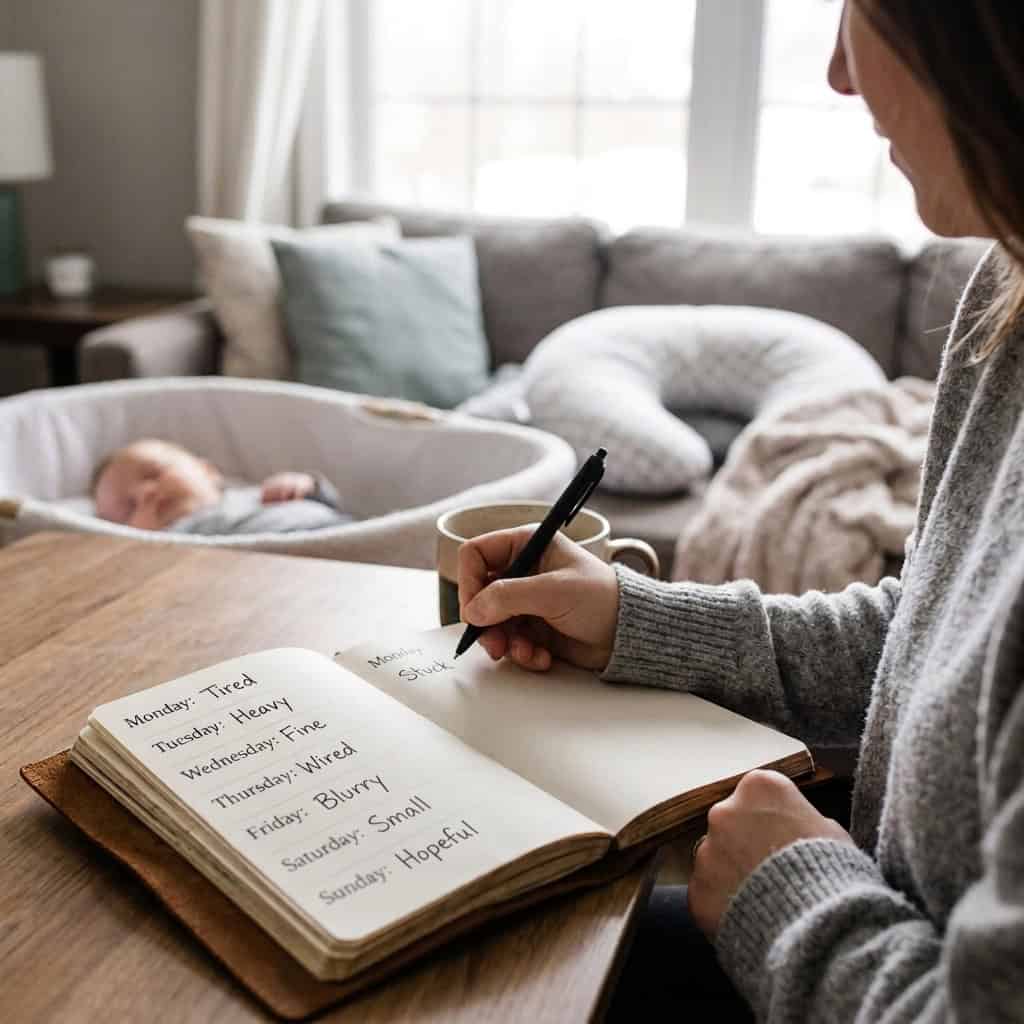
Prompt 1: one word for how today feels
Just one word. That’s the whole entry.
Tired. Sad. Fine. Wired. Heavy. Blurry. Small.
The word is a data point. Do this every day for a week and you start to see patterns. What days are heavy. What days are hopeful. When it feels stuck.

Prompt 2: one thing my body did today that I want to thank it for
Not thank my body for its beauty, that one is aspirational. Something specific and small.
“Thank you for staying standing while I made lunch.” “Thank you for making enough milk today.” “Thank you for the deep breath at 3am.” “Thank you for walking to the mailbox.”
Your body is doing enormous things constantly. Notice one.

Prompt 3: one small joy from the last 24 hours
Any joy. The weight of the baby asleep. The specific fold of a blanket. A song you heard. The taste of a really good coffee.
The point is that noticing joy trains your brain to look for it. Not because joy fixes anything, but because it’s easier to see once you know to look.

Prompt 4: one thing I need that I haven’t asked for
Uncomfortable but useful. What do you need? Have you named it? Have you asked?
Sometimes the answer is embarrassing (“I need my partner to actually notice when I’m at capacity”). Sometimes it’s small (“I need more water”). Sometimes it’s big (“I need to talk to a therapist”).
Naming is the first step. You don’t have to ask today. But name it.

Prompt 5: one thing about the baby I want to remember
The specific way they smell right now. The tiny fist. The way they look at you when they nurse. The sound they make when they sleep.
You’ll forget this. Everyone says so, and it’s true. Not the big things, the small ones. Write one down.
Come back in five years and read them. You’ll cry.

Free · takes ten seconds
Whatever time you have today, it counts.
Tell The Window how many minutes and how many hands you have free, and it picks one small thing for you: a stretch, a shower, a page of a book, ten minutes of nothing. A jar counts them up over the week.
No email needed. Works on your phone, one-handed.
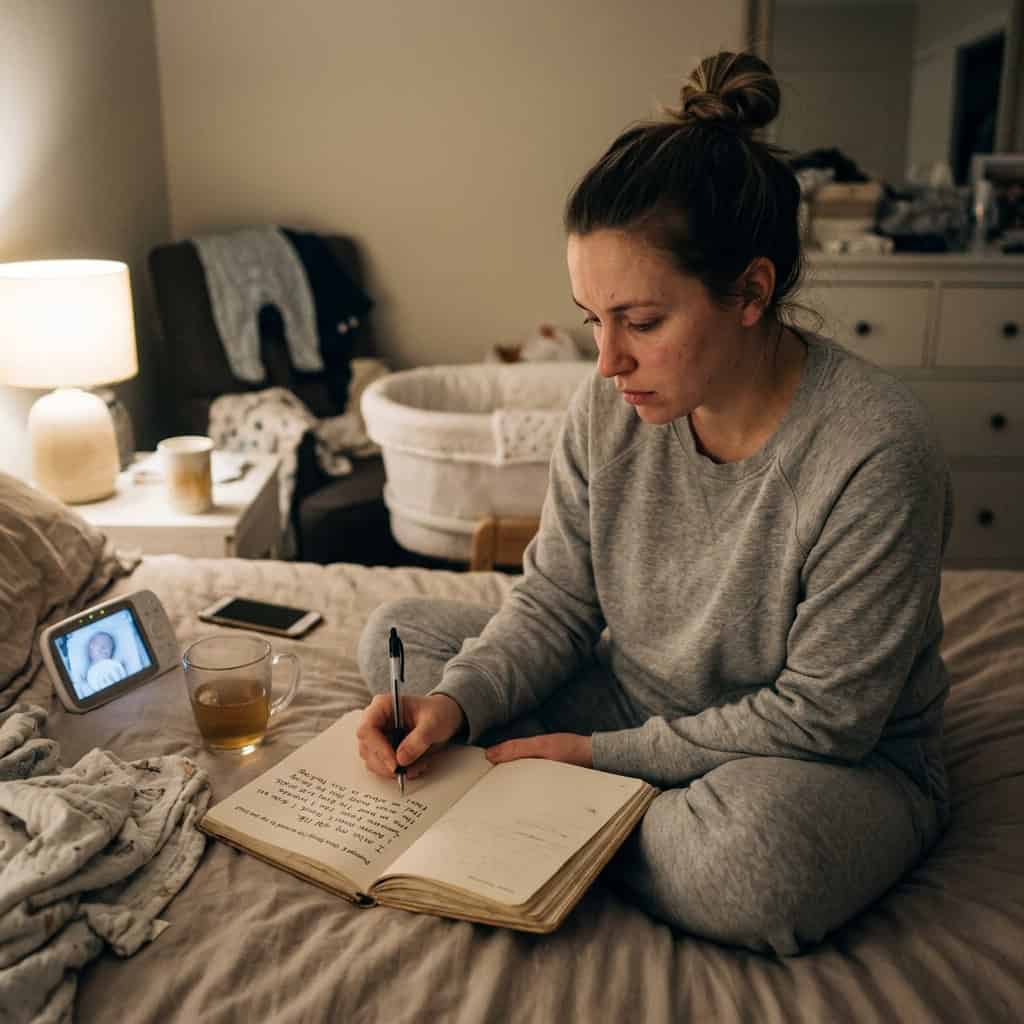
Prompt 6: one thing I’m scared to say out loud
This one is for the harder feelings. The ones that don’t feel appropriate to say to friends. The ones you’re ashamed of.
“I miss my old life.” “I don’t feel bonded with the baby yet.” “I resent my partner right now.” “I’m scared I’m not good at this.” “I want to be alone for a whole day.”
Write it. Nobody will see it. But you’ll have said it, even to yourself, and that matters.
And if what comes out on the page frightens you, if it keeps coming back, if it’s about hurting yourself or the baby, please say it to a real person today. Your doctor, your midwife, a crisis line, someone who loves you. Those thoughts are more common than anyone tells you and they get better with support. You do not have to sit with them alone.
Prompt 7: one thing I miss (without judgment)
Sleep. Wine. Friends. Concerts. My body. My freedom. My old job. Long showers. Reading a full book.
Whatever you miss. Write it. Missing something isn’t disloyal to the baby. It’s honest.
Grief and love live in the same house.

Where to actually keep it (the notes app is a real journal)
You do not need a notebook. The notebook is a nice idea that mostly lives in a drawer with three pages filled in, and then it becomes one more thing you feel behind on.
Open the notes app on your phone. Make one note. Call it whatever you want. Pin it to the top so it’s the first thing you see when you open the app. Every entry goes in that one note, newest at the top, with the date. That’s the entire system.
The phone is already in your hand at 2am. It’s already there during the feed. Putting the journal where you already are is the difference between a practice that happens and a beautiful notebook that doesn’t.
Free · five minutes on Sunday night
Five minutes on Sunday night, and the whole week is dressed.
Tap the kind of day each day is and The Sunday Reset lays out seven outfits, one window of time for you each day, and the three things that matter this week. Print it, or have it emailed.
Free. Made for the mornings when choosing is the hard part.
When you have nothing to say
Some days the honest answer to every prompt is blank. Not sad, not happy, just nothing there to report.
Write “nothing today” and close the app. That is a legitimate entry. A week of “nothing today” tells you something real about the week, and you will be glad later that you kept the record instead of skipping it because it wasn’t interesting enough.
Journaling is not performance. Nobody’s reading. There’s no minimum.
What to do with the entries once you have them
Nothing, mostly. That’s allowed. The value is in the writing, not the rereading.
But if you want more from them, try this. Every Sunday, scroll back through the week’s entries and read them in one sitting. It takes two minutes. You will notice things you could not notice inside the day itself: that Thursdays are always the hardest, that the word tired shows up seven times in a row, that the same unasked need keeps appearing.
That is the point where the journal stops being a diary and starts being information. Information you can actually act on.
How to make it a habit (or not, that’s also OK)
If you want it to be a habit: pick one prompt and use it daily. Same one for a week. The notes app is fine.
If habits feel like pressure: don’t. Do it when you feel like it. One entry a week is a journal. One entry a month is a journal. The habit is not the point, the noticing is.
Attach it to something that already happens if you can. The first feed of the morning. The last one at night. The habit that survives is the one that rides along with something you were already doing.
Feel Your Best, Give Your Best. You Matter Too.
Three sentences. That’s a journal entry. Save these prompts. Screenshot them. Come back the next time you feel the swirl and don’t know where to put it.
If you want more small daily practices in this exact size, the free 5-Day Challenge is one a day for five days. And if you’d like a low-effort way to feel more like yourself in the mirror while you’re at it, the free Postpartum Lookbook is yours.
You still have inner life, mama. It’s just quieter right now.

You deserve to be looked after too
A stylist who already knows you, every morning.
The Atelier is Anah every morning, already knowing your season, your shape and your closet. The community, the magazine, the planner, and Dress me for the mornings when choosing is the hard part.


