You button your shirt, glance in the mirror and see a gap between two buttons. You smooth the front. It closes for a moment, then opens again when you sit or reach. By the time you leave, you are thinking about the shirt instead of your day.
A gaping button-down is a fit or construction question, not a verdict on your body. The solution depends on whether the shirt needs more room, better shaping, a different button position or a change to the way you are wearing it.
Before buying another size or adding a fastening, look at what the fabric is doing. One careful try-on can tell you more than repeatedly pulling the two edges together.
Notice when the gap appears
Try the shirt with the bra you intend to wear. First stand naturally with your arms resting. Then sit, reach forward and relax again. Avoid holding your shoulders back in a position you would never maintain through an ordinary afternoon.
Does the gap exist all the time, only while sitting, or only when the shirt is tucked? Does it sit directly across the fullest part of your bust? Are there pulling lines toward the armholes or waist? Is the fabric otherwise relaxed?
Make a specific note: “Front is tight across the bust even when untucked,” or “Plenty of room, but the placket opens between widely spaced buttons.” Those observations lead to different next steps.
Separate missing room from a fastening gap
| What you notice | What may be involved | What to try first |
|---|---|---|
| Tension across the whole front | Insufficient room or unsuitable shaping | Another size or a cut with room in the relevant area |
| A small gap between buttons, with relaxed fabric elsewhere | Button spacing or placket construction | A tailor’s assessment of an additional closure |
| Gap appears after tucking | Fabric pulled downward or caught at the waist | Try untucked, then adjust the tuck |
| Bust fits but shoulders and sleeves feel too large | Proportions of the cut | A differently shaped shirt rather than another size alone |
Use this as a way to investigate, not a diagnosis from a photograph. Several factors can occur together. A shirt may need more bust room and have inconvenient button spacing.
Check the bra without asking it to shrink you
Different bras change the outline beneath a shirt. A cup seam, coverage level or shape may affect where fabric rests and how the placket lies. That is a reason to try the intended combination, not a reason to squeeze into a less comfortable bra.
If the shirt worked with one bra and gaps with another, decide which piece better serves your day. You might pair the shirt with the comfortable bra it already suits, reserve it for another routine or choose a different shirt.
For a pumping day, include the equipment in a separate clothing check according to its instructions. A shirt that closes comfortably over your bra may not have enough room when a wearable pump is in place.
Try a different cut before assuming every shirt will fail
A straight-cut shirt, a darted blouse and a relaxed shirt can distribute their room differently. The same labelled size does not mean the same bust allowance, shoulder width or armhole shape.
If you like a defined shoulder, look for a cut that provides the bust room you need without making the shoulder much wider than you prefer. If you enjoy a loose silhouette, choose one deliberately and check the extra fabric during feeding.
Also notice length. A shirt that is short through the front may keep pulling out of a tuck or moving upward over the bust. More width alone may not create the length you want. Compare the whole shape with a similar shirt that already works.
Test the tuck, waistband and outer layer
Put the shirt on untucked first. If it lies comfortably, try your usual bottom and tuck. A firm waistband or deep tuck can hold the lower fabric while your upper body moves, changing the tension through the front.
Try a shallower tuck, a different bottom or wearing the shirt untucked. Sit after each change. You are looking for a repeatable arrangement, not a momentary pose that happens to close the gap.
A close-fitting cardigan or jacket can also change how the shirt sits. Test the base outfit before adding the layer, then compare. If the opening only strains with the jacket on, that combination may be the problem.
Know when an extra closure might help
If the shirt has comfortable room and one small section of the placket separates, ask a tailor whether a discreet additional closure is suitable. They can assess placement, fabric strength and whether the fastening will show or pull.
Explain that you need to open the shirt for feeding. A permanent stitch across the opening may keep it closed while making the garment less useful. Any proposed adjustment should preserve the access you actually need.
Extra fastenings cannot add missing fabric. If the whole front is stretched, holding one point closed may shift the pulling elsewhere. Avoid building your everyday outfit around a temporary fix that repeatedly releases or makes the opening harder to use.
Consider wearing the shirt open

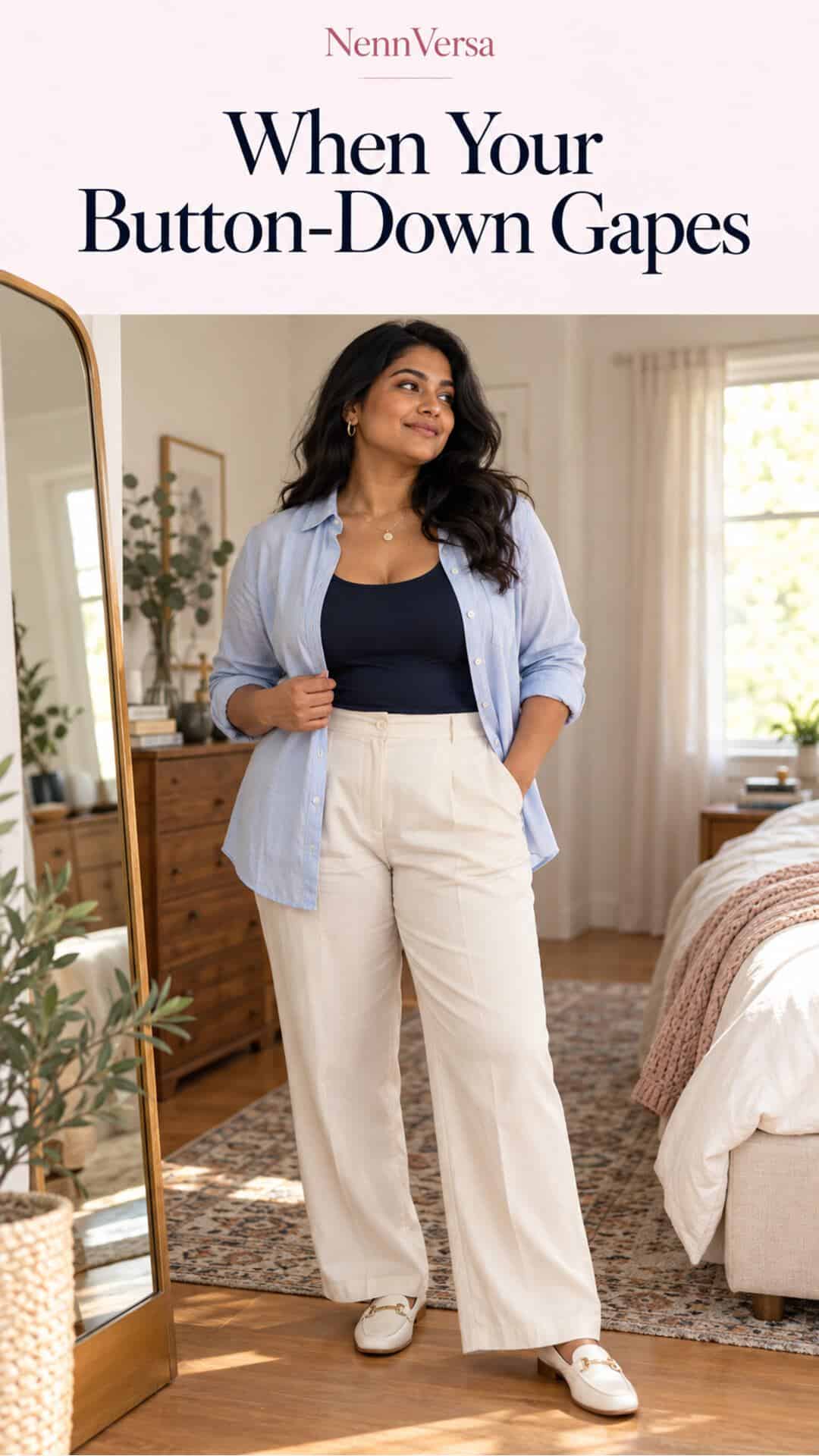
An otherwise useful shirt may work as an open layer over an accessible tank or top. This changes the garment’s job: it provides colour, sleeves or an outer shape while the underlayer provides the main coverage and feeding access.
Try a pale blue shirt over a navy nursing tank with comfortable trousers. Or pair a striped shirt with an ivory accessible top and an olive skirt. Check that the shirt fronts stay out of the way when you use the underlayer.
This is an option if you like the appearance and the extra layer feels manageable. You do not need to add a tank and leave every shirt open. Sometimes a different blouse is simply a better match.
Build three outfits with fewer adjustments
The untucked work shirt
Choose a functioning button-front shirt with comfortable bust room and a hem you like untucked. Pair it with straight-leg trousers and loafers or flats. Check it while seated at a desk-height table, including any cardigan you intend to wear.
Removing a tuck can simplify the feeding sequence as well as change the tension. You still need to inspect the opening and bra together.
From the capsules
The Year Round Capsule
Two hundred nursing-friendly outfits from fifty-six pieces, fifty for every season, laid out and then worn. $29 once, yours to keep.
The softly shaped blouse
Try a blouse with shaping that suits your shoulders and bust, paired with a comfortable skirt. Check that its buttons genuinely open and that a lining does not stay closed underneath.
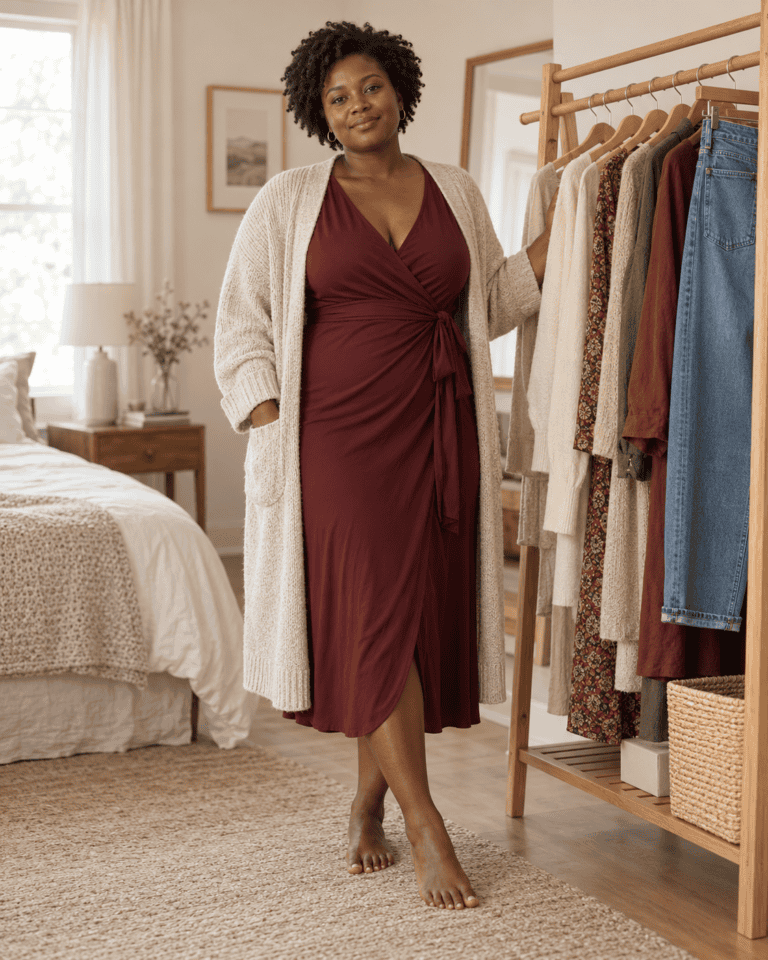
A burgundy blouse and navy skirt can make a complete outfit without another layer. Choose the colours and silhouette because you enjoy them, rather than following a rule about making your bust look smaller.
The open-shirt casual outfit
Use a roomy shirt over an accessible tank with joggers or relaxed trousers. Practise moving the shirt fronts, reaching the underlayer and restoring the outfit. If the shirt is long, check it does not catch beneath you when seated.
Make your next online purchase more informed
Ask for the finished-garment chest measurement, shoulder width and front length in the size you are considering. Confirm how those measurements were taken. A flat chest width is a different measurement from a body bust circumference.
Look closely at the placket and button placement, but do not assume their position on a model predicts their position on you. Request a close-up if the detail is hidden. Check fabric composition, any stretch, lining and return terms.
Keep a short reference from a shirt you enjoy: “Roomy through the front, defined shoulders, hem works untucked.” That is a more useful shopping brief than a universal instruction to size up.
Questions moms often ask
Should I always buy the next size up?
No. It may provide the room you need, but it may also change the shoulders, sleeves and neckline. Compare the actual fit and another cut if necessary.
Will an extra button fix the gap?
It may help a small spacing problem when the fabric already has enough room. Ask a tailor to assess it. A new button will not solve overall tension across the shirt.
Can a button-down still be useful if I wear it open?
Yes, if you like it as a layer and the underlayer works for feeding. Try the complete combination, including the temperature and coverage you prefer.
The Nursing Mama Fashion Commandments
Twelve rules I wish someone had told me postpartum. Print them. Screenshot them. Live by them.
- Nursing bra always. Regular bras become instruments of pain the day letdown surprises you.
- Nursing pads on your body + a spare pair in your bag. Every single time you leave the house. No exceptions.
- Extra top in your bag — for YOU, not the baby. Because leaks, spit-up, and coffee-spills don’t care about your outfit plan.
- If it takes more than 5 minutes to figure out how to nurse or pump in it, it’s not the right outfit today. Feeding access is comfort. Comfort is not optional.
- Belt under the bust (empire) or below the belly with drape — never at the belly button. Your postpartum body deserves flattery, not compression.
- Comfortable waistband is non-negotiable. Elastic, wrap, or pull-on. Zippers are a Sunday-only luxury for now.
- Dark tones, prints, or textures — not thin light solids. Because letdown marks are real and you deserve clothes that don’t advertise them.
- Machine-washable everything. Dry-clean is not real-mama fashion. If it can’t survive a spit-up rinse, it’s not in rotation.
- Cross-body bag only. Hands stay free for the carrier, the toddler, the coffee, the door, the meltdown.
- Comfortable shoes always. You’re carrying a car seat and a diaper bag. This is not the season for a heel you can’t run in.
- Get dressed BEFORE the kids see you if you can. It changes the whole day — for them and for you.
- One accessory — earrings, a lip color, a scarf — counts as “put together.” That’s the whole game. You get to feel like yourself again.
Change the detail that is causing the problem
Start with one shirt, one comfortable bra and one seated trial. Identify whether the issue is room, shaping, length, button spacing or styling. That gives you a practical next step without turning a small gap into a whole-wardrobe crisis.
Explore NennVersa and The NennVersa Atelier for help turning useful fit observations into outfits you can wear with less adjustment. We focus on you, Mom.