Button-front shirts appear on almost every nursing wardrobe list. Yet a row of small buttons can be the very thing that makes an outfit frustrating, especially if gripping, pinching, reaching, or repeating a movement is difficult for you.
You do not have to make yourself better at using a particular fastening before you deserve an easier outfit. Start with the movements you can manage comfortably, then choose clothing around them.
This is a clothing guide, not a diagnosis or treatment plan. If pain, weakness, numbness, or restricted movement is affecting daily tasks, seek individual advice from a qualified clinician. An occupational therapist can help assess dressing tasks and possible aids; the Arthritis Foundation describes that practical role.
Describe the difficult movement
“Buttons are hard” is a useful starting point. A more detailed description helps you find an alternative. Is the problem pinching a tiny button, pushing it through a tight hole, using both hands together, reaching a back closure, or repeating the task several times?
Notice the closing step too. A top can be easy to open and surprisingly difficult to restore. A wrap tie may move aside easily but require a knot you dislike tying. A zip may be easy to pull down but hard to engage at the bottom.
Make a short note from your own experience: “I can move a loose panel, but tight snaps are uncomfortable,” or “I prefer closures I can see in front of me.” That is more useful than choosing a whole wardrobe based on a generic promise of one-handed access.
Match the fastening to the movement you can manage
There is no closure that is easiest for everyone. Compare candidates by what they require from your hands and arms.
| Option to try | What to check |
|---|---|
| A liftable separate top | Can you lift and hold it without uncomfortable shoulder movement or bunching? |
| A true wrap opening | Can you move the panel and restore it? Does the tie add another difficult task? |
| A designed lift or overlap panel | How many layers must move, and do they stay where you need them? |
| A zip or larger fastening | Can you reach, grip, start, and close it comfortably? |
| An open outer shirt or cardigan | Does the accessible garment underneath already work on its own? |
In its occupational therapist’s dressing guidance, Arthritis UK discusses options such as fewer buttons, button hooks, and alternative fastenings. These are possibilities to assess, not a guarantee that snaps or hook-and-loop closures will feel easier to every reader.
Count the steps in the whole outfit
A top advertised as easy access can still sit over a bra you find difficult to release. An open cardigan may add fabric that falls forward. A tucked shirt may require lifting, unfastening, untucking, and then arranging several layers again.
Lay out the complete combination and follow the access route from the outside in. Name each action: move cardigan, lift top, open underlayer, restore underlayer, lower top. If a step is repeatedly frustrating, change that part first.
You may find that the simplest improvement is leaving a shirt untucked or choosing an open layer instead of a closed sweater. You do not necessarily need to replace every garment.
Try the outfit before holding your baby
Rehearse the clothing movements while seated and without your baby in your arms. Give yourself a calm chance to discover where fabric catches or a closure is out of reach. Use both hands whenever that is what you need; independence does not require doing every task one-handed.
If you need two hands to arrange clothing during a real feed, first place your baby somewhere safe for their age and situation or ask a trusted adult to help. Do not balance the baby while struggling with a fastening.
A clothing rehearsal should not involve pushing through pain. Stop a movement that hurts and choose another approach or get individual help. The aim is a more manageable task, not a timed challenge.
Build three outfits with fewer fiddly steps

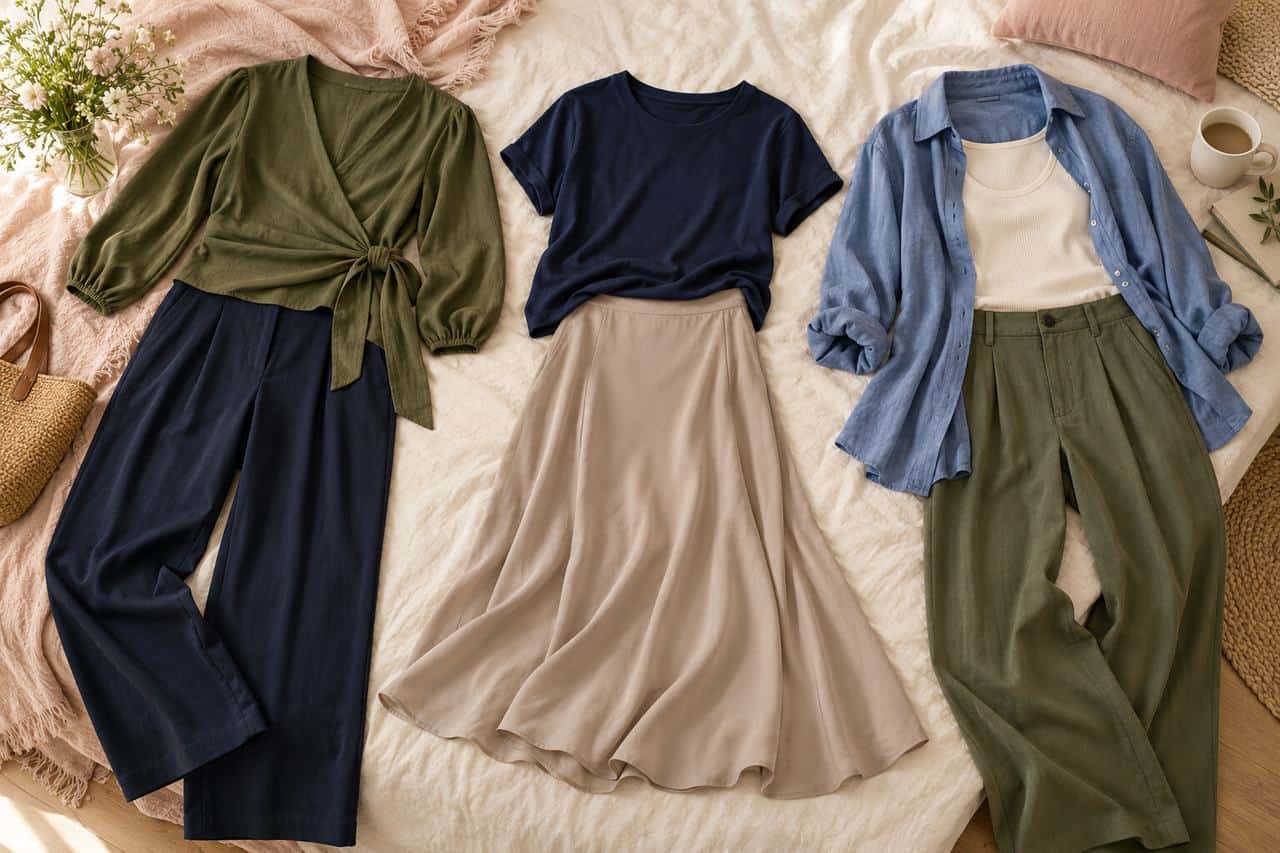
A true wrap top with comfortable trousers
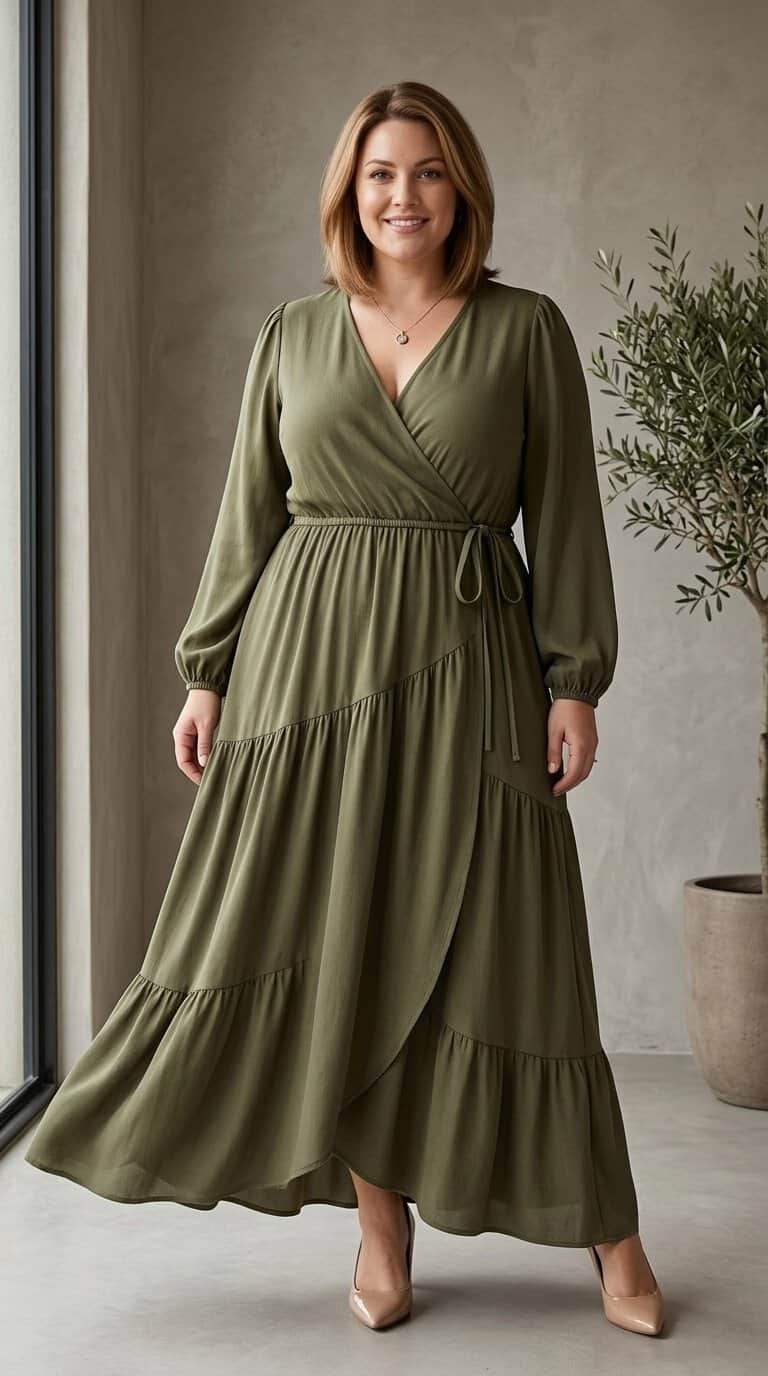
Try an olive wrap top over your chosen accessible underlayer, with navy pull-on trousers and familiar shoes. Check whether the wrap panels move sufficiently and whether the tie can remain arranged during access. Some wraps are sewn closed or have a fixed insert, so inspect the actual garment.
If managing the tie is the difficult part, this is not your easiest option simply because the neckline looks accessible. A designed overlap top may be a better candidate, provided its inner layers work for you.
A loose separate tee with a comfortable skirt
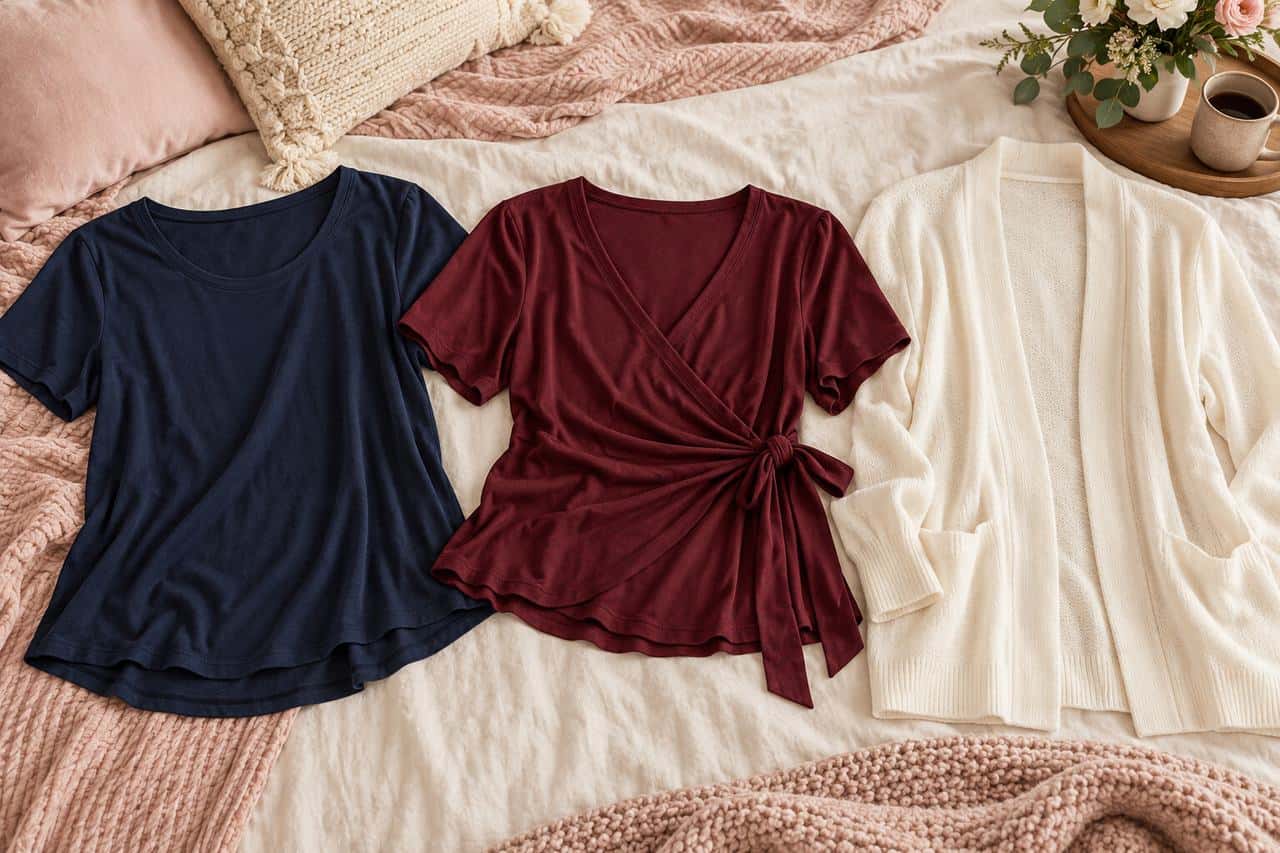
A navy tee and taupe skirt can create an everyday outfit without a row of front fastenings. Try the lift movement with the underlayer you intend to use. Check how much fabric gathers and whether you can restore it comfortably.
If lifting overhead or holding fabric is difficult, move on to a front-opening option. The tee is an alternative to test, not a universal solution.
An open shirt over an accessible base
Wear a blue shirt open over a base layer whose access already works, with olive trousers or a familiar skirt. You get the colour and structure of a shirt without needing to operate every button during feeding.
Check whether the open fronts stay out of the way and whether the extra layer suits the temperature. If you spend the whole feed gathering fabric, a shorter or lighter outer layer may be easier.
Ask useful questions before buying an aid
A dressing aid may be helpful when it matches the task. Before buying, identify the exact movement you want it to assist, whether you can position it, and whether it works with the garment you own.
For a button hook or zip aid, seek a demonstration or guidance appropriate to your needs. Consider how you will store and retrieve it. An aid buried in a bag is less useful than one available where you get dressed.
Avoid improvised loose parts or sharp fasteners near your baby. If you want a permanent clothing change, ask a qualified tailor or relevant professional about construction and suitability rather than attaching something that may come loose.
From the capsules
The Year Round Capsule
Two hundred nursing-friendly outfits from fifty-six pieces, fifty for every season, laid out and then worn. $29 once, yours to keep.
Make help specific
You can ask for practical help without turning getting dressed into a negotiation. For example: “Could you close the back fastening before we leave?” or “Please hold the baby while I arrange my top.”
If another person helps regularly, tell them which order works and which movements are uncomfortable. Keep your preferences central. Assistance should support the way you want to dress, rather than deciding your clothes for you.
Prepare one reliable outfit together and note what makes it manageable. That can become your fallback for a tiring morning, while you continue trying other styles at your own pace.
Keep a simple access note for shopping
Before buying another top, record the route that worked and the detail that made it manageable. You might write: “Front opening I can see; no tight wrist cuffs; underlayer releases comfortably; easy to close while seated.” Take that note into a shop or use it to ask a seller for specific photographs.
If you try a new closure, check both the first opening and repeated use. A fastening that feels manageable once may be tiring across your day. Keep your trusted outfit available while you decide whether the new piece is useful.
Your note can change with your needs. It is a practical reference for choosing clothes, not a test you must pass or a permanent limit on your style.
Questions moms often ask
Are snaps easier than buttons?
Sometimes, but opening force, placement, and grip all matter. Test the actual fastening if you can. A stiff snap may be less comfortable than a larger, easy-moving button.
Does easy access mean I have to wear loose clothes?
No. The useful shape is one that gives you the movement, access, and comfort you need. You can enjoy definition or a close fit where it works for you.
Can the same outfit work for pumping?
It may, but pumping adds equipment-specific access and support requirements. Check the full setup separately using your manufacturer’s instructions.
The Nursing Mama Fashion Commandments
Twelve rules I wish someone had told me postpartum. Print them. Screenshot them. Live by them.
- Nursing bra always. Regular bras become instruments of pain the day letdown surprises you.
- Nursing pads on your body + a spare pair in your bag. Every single time you leave the house. No exceptions.
- Extra top in your bag — for YOU, not the baby. Because leaks, spit-up, and coffee-spills don’t care about your outfit plan.
- If it takes more than 5 minutes to figure out how to nurse or pump in it, it’s not the right outfit today. Feeding access is comfort. Comfort is not optional.
- Belt under the bust (empire) or below the belly with drape — never at the belly button. Your postpartum body deserves flattery, not compression.
- Comfortable waistband is non-negotiable. Elastic, wrap, or pull-on. Zippers are a Sunday-only luxury for now.
- Dark tones, prints, or textures — not thin light solids. Because letdown marks are real and you deserve clothes that don’t advertise them.
- Machine-washable everything. Dry-clean is not real-mama fashion. If it can’t survive a spit-up rinse, it’s not in rotation.
- Cross-body bag only. Hands stay free for the carrier, the toddler, the coffee, the door, the meltdown.
- Comfortable shoes always. You’re carrying a car seat and a diaper bag. This is not the season for a heel you can’t run in.
- Get dressed BEFORE the kids see you if you can. It changes the whole day — for them and for you.
- One accessory — earrings, a lip color, a scarf — counts as “put together.” That’s the whole game. You get to feel like yourself again.
Choose clothes that cooperate with you
Getting dressed should not depend on proving that you can manage a difficult closure. A useful wardrobe respects your hands, your reach, your energy, and your style.
Find more practical outfit ideas through NennVersa and The NennVersa Atelier. We focus on you, Mom.