Booking feeding support can bring relief and another small worry: what are you supposed to bring, remember, or explain?

You do not need a perfectly organized feeding log or the right words for every concern. The purpose of the appointment is to get help with your situation and goals. A little preparation can make it easier to explain what is happening and leave with a plan you understand.

This guide helps you prepare questions, clothing, equipment, and notes. It does not assess feeding, diagnose a problem, or replace advice from your own care team. If you or your baby need prompt medical attention, seek appropriate care rather than waiting for a routine appointment.
Start with the reason you want help
Write one sentence describing what you most want to address. It can be simple: “Feeding hurts and I want help understanding why,” “I need help using my pump comfortably,” or “I want to discuss a feeding plan I can manage when I return to work.”
You may have several concerns, but identifying the most pressing one gives the conversation a starting point. You do not need to decide the cause before you arrive. Describe what you notice rather than diagnosing yourself from an online checklist.
Your goals matter too. Say whether you want help with direct breastfeeding, expressing milk, mixed feeding, a transition, or another part of your situation. A useful plan needs to account for both the feeding concern and what is realistic for your family.
Confirm the right appointment and provider
Ask what type of support the appointment offers and who you will see. The Office on Women’s Health describes several routes to breastfeeding support, including International Board Certified Lactation Consultants and other trained support providers. Their roles and services are not identical.
When booking, briefly explain the concern and ask whether this service is suitable or whether another clinician should be involved. If you have a medical or medication question, ask who is qualified to assess it. Do not assume every appointment includes the same clinical services.
Also check the location, length, fee, referral requirements, and any coverage or reimbursement arrangements relevant to you. Ask how to get help if the concern changes before the appointment. These details reduce uncertainty without requiring you to research everything yourself.
Follow the clinic’s own preparation instructions
Ask whether your baby should attend, what equipment to bring, and whether there are any specific preparation requests. If observing a feed is part of the visit, ask how they would like to accommodate your baby’s usual feeding needs. Continue following your current care plan; do not independently delay a feed to produce a demonstration.
As one example, University of Rochester’s lactation clinic asks parents working on latching to bring their baby, recommends bringing pump equipment when expression is a concern, and includes the baby’s usual food among items to bring. Your own service may give different instructions.
If the visit is virtual, confirm that the provider can see you in your location and ask how the appointment works. Check the connection and camera setup in advance, without assuming you need to record or send intimate photographs.
Bring a short, useful set of notes
Use information you already have, plus anything the clinic specifically requests. Do not create an exhausting tracking project simply because an appointment is approaching.
Your note could include:
- The main concern, when you first noticed it, and whether it changes during or after feeding or pumping.
- What you have tried and what happened.
- Your current feeding arrangement and any existing care plan.
- Relevant records or measurements already provided by your clinicians.
- The questions you most want answered.
If you have a feeding or pumping record, bring it in the form you already use. Ask the clinician what information is useful for follow-up instead of assuming you need to track everything indefinitely.
For symptoms, plain descriptions are enough. “This area rubs when I pump” is useful information. You do not need technical terminology to deserve a careful assessment.
Also bring a list of medicines and supplements, including herbal products, and relevant health records. Pregnancy, Birth and Baby’s appointment guidance includes these among useful preparation items. Tell the clinician what you currently take; ask your clinician or pharmacist before changing a prescribed medicine.
Pack the equipment related to your question

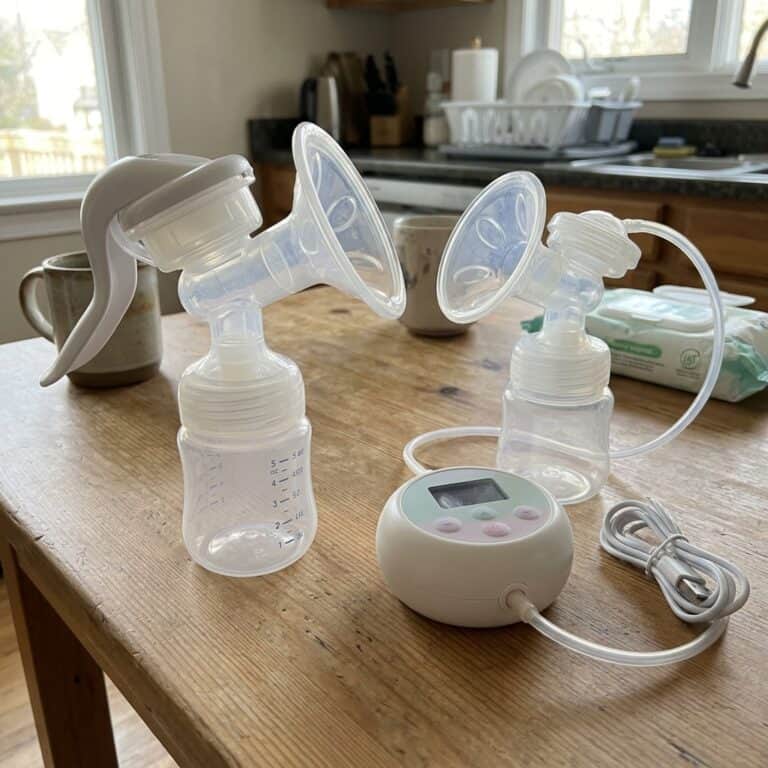
If pumping is part of the appointment, bring the pump and the actual components you use, as requested by the service. Include the power arrangement or charged device, relevant instructions, and any bra or accessory involved in the problem.
Knowing the model name can help if you cannot bring everything. Ask the clinic what it needs rather than carrying a large collection of unrelated products. Bring items appropriately cleaned and stored, and keep any used items separate.
If you want help with the interaction between clothing and equipment, wear or bring the relevant layer. A pumping bra that causes difficulty is useful context; a different bra that hides the problem may make your question harder to demonstrate.
Choose clothes that make the visit easier
Wear something you can open or move comfortably. A functioning button-front shirt, a usable Henley, or a liftable top may suit you. The right choice depends on the access needed and what you prefer wearing.
Check the underlayer too. If your outfit has multiple panels, decide whether that complexity helps you or simply adds another task. You can bring a removable layer for comfort and a spare top if that makes the trip easier.
You do not need to dress up to prove that you are coping, and you do not have to arrive looking distressed to demonstrate that you need support. Choose clothes that let you focus on the appointment.
Make your preferences clear
You can ask the provider to explain an assessment before it happens and tell them what would help you feel comfortable. If an examination or demonstration is proposed, ask questions about what it involves.
When booking, you can ask about a support person, a chaperone, privacy, language support, or accessibility needs. Availability and arrangements vary, so checking ahead can help. The Rochester clinic’s information, for example, explicitly welcomes a support person and describes chaperones on request; ask your own service what it offers.
If someone accompanies you, agree on their role. They might take notes with your permission, help manage your belongings, or remind you of a question. Their job is to support the conversation, not answer over you.
Ask questions that lead to a usable plan
You do not have to ask every question below. Choose the ones that match your reason for attending.
- “What are you noticing, and what does it mean for our next step?”
- “Can you show me, then watch me try so we can check that I understand?”
- “Which change should I focus on first?”
- “How will we know whether this is helping?”
- “What should I do if this is painful, does not work, or is not manageable at home?”
- “What needs medical assessment, and who should provide that?”
- “When should we follow up, and how do I contact the right person?”
If the proposed plan feels too complicated, say so. Explain the practical constraint: limited help, caring for another child, returning to work, or difficulty obtaining supplies. Ask what can be simplified or prioritized rather than leaving with a plan you already know you cannot follow.
Leave with the next steps in writing

Before the appointment ends, summarize what you understand: the first action, what to observe, and when to seek further help. Ask the provider to correct anything you have misunderstood.
Request a written plan or use your own notes. Include who handles any referral or follow-up, how to contact the service, and what to do if the situation changes outside its usual hours. You should not have to reconstruct a complex conversation from memory after a tiring day.
If a suggested product or piece of equipment is involved, ask what feature is needed and why. Clarify whether you can use something you already own and whether an alternative would meet the same need.
A simple appointment note you can copy
My main concern:
What I am noticing and when:
My goal:
What I hope will become easier:
Relevant context:
Current plan, equipment, records, and practical limits:
My three questions:
1.
2.
3.
Agreed next step:
What I will try, what I will observe, and when we will review:
Who to contact:
Routine follow-up and help if the situation changes:
Keep this note somewhere you can find it. It is a memory aid, not a self-diagnosis tool or a measure of how well you are doing.
Common questions
Can I attend if I use formula or mixed feed?
Tell the service your current arrangement and what help you want. Ask whether its scope matches your needs. You do not need to disguise part of your feeding routine to ask for support.
What if my baby feeds differently during the appointment?
Explain what usually happens and how the visit differs. Ask what observations or follow-up would help. One appointment is a conversation about your broader experience, not a performance you have to get right.
What if I forget my notes or equipment?
Tell the provider what is missing and ask how to proceed. Preparation can help, but it is not a condition for deserving support.
You can ask for help before everything feels organized
Write your main concern, confirm the service’s instructions, and pack only what is relevant. Let the appointment help you work out the next step.
If getting dressed for the trip is another decision you would like to simplify, NennVersa’s My Out-the-Door Outfit Plan can help with the clothing side. Feeding assessment and treatment belong with your qualified care team.
Your questions, comfort, and capacity are part of the conversation. You matter here too.