You can love a shirt and still discover that feeding in it is a struggle. You can also overlook a perfectly useful top because it does not have “nursing” in the product name. After having a baby, the important question is often less about the label and more about what the garment lets you do.
Many everyday clothes can work for breastfeeding with a different pairing, a usable front opening, or a better underlayer. Others will remain awkward, and you are allowed to put them aside. Making your wardrobe easier to use should not mean stretching every neckline or tolerating clothes that bother you.
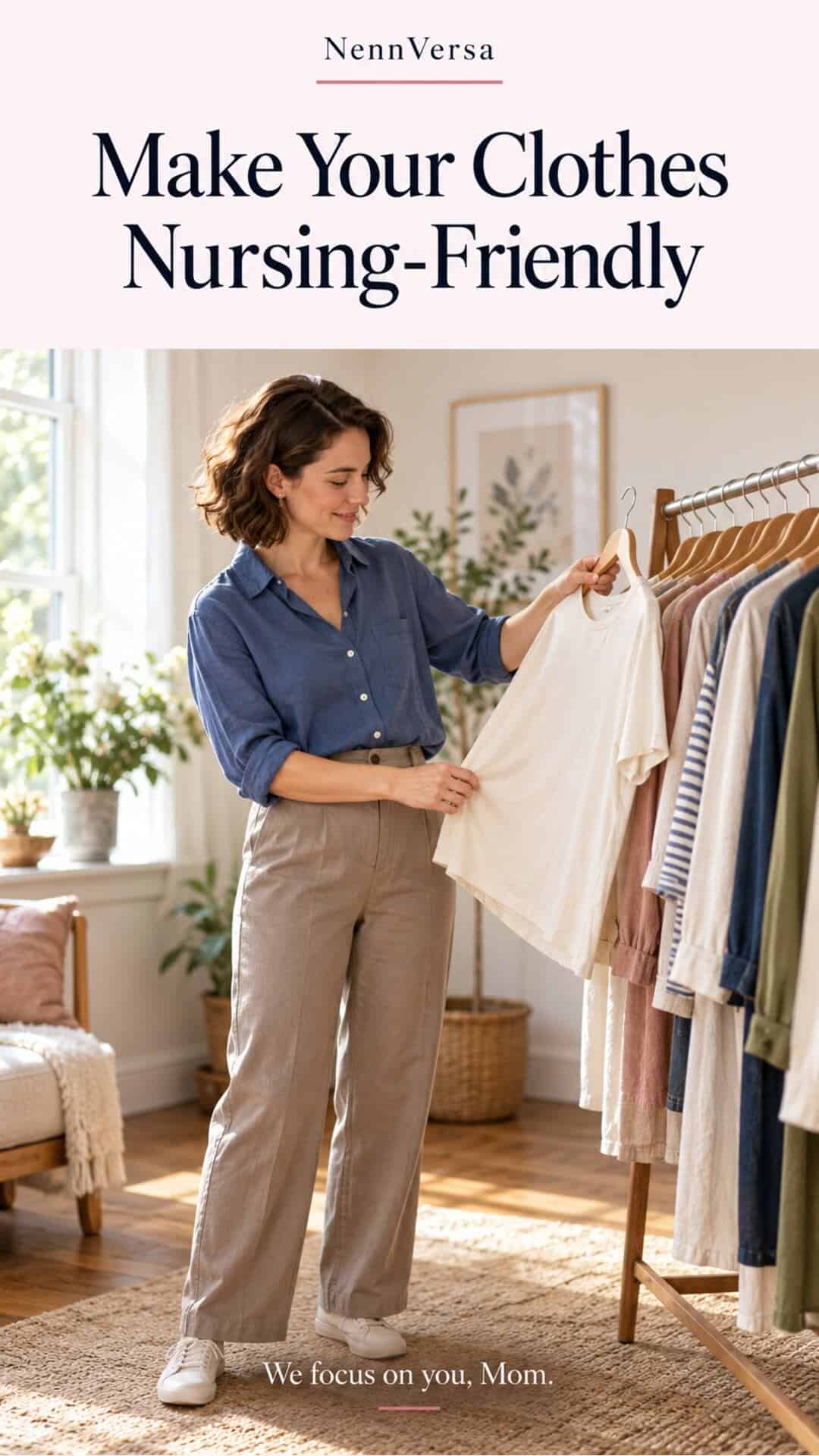
Start with one piece you already enjoy wearing. Find its access route, try it while seated, and build the rest of the outfit around that route. Here is how to do that without turning the process into another shopping project.
Find the opening before adding anything
Lay the garment flat and look at how it is constructed. Can the front actually open? Can the hem lift without the shoulders becoming tight? Does a wrap separate, or is it stitched closed? Is there a lining underneath that blocks the opening you expected to use?
These small details explain why two tops that look almost identical can behave differently. A decorative button placket gives you no more access than an ordinary closed front. A zip may stop too high. A stiff lining may prevent an otherwise generous neckline from moving.
Choose one of three routes to test: open from the front, lift from below, or move a genuinely flexible opening aside. If none feels comfortable, keep the piece for a different stage or situation. You do not have to make every garment perform every job.
Use the two-shirt method when you like the coverage
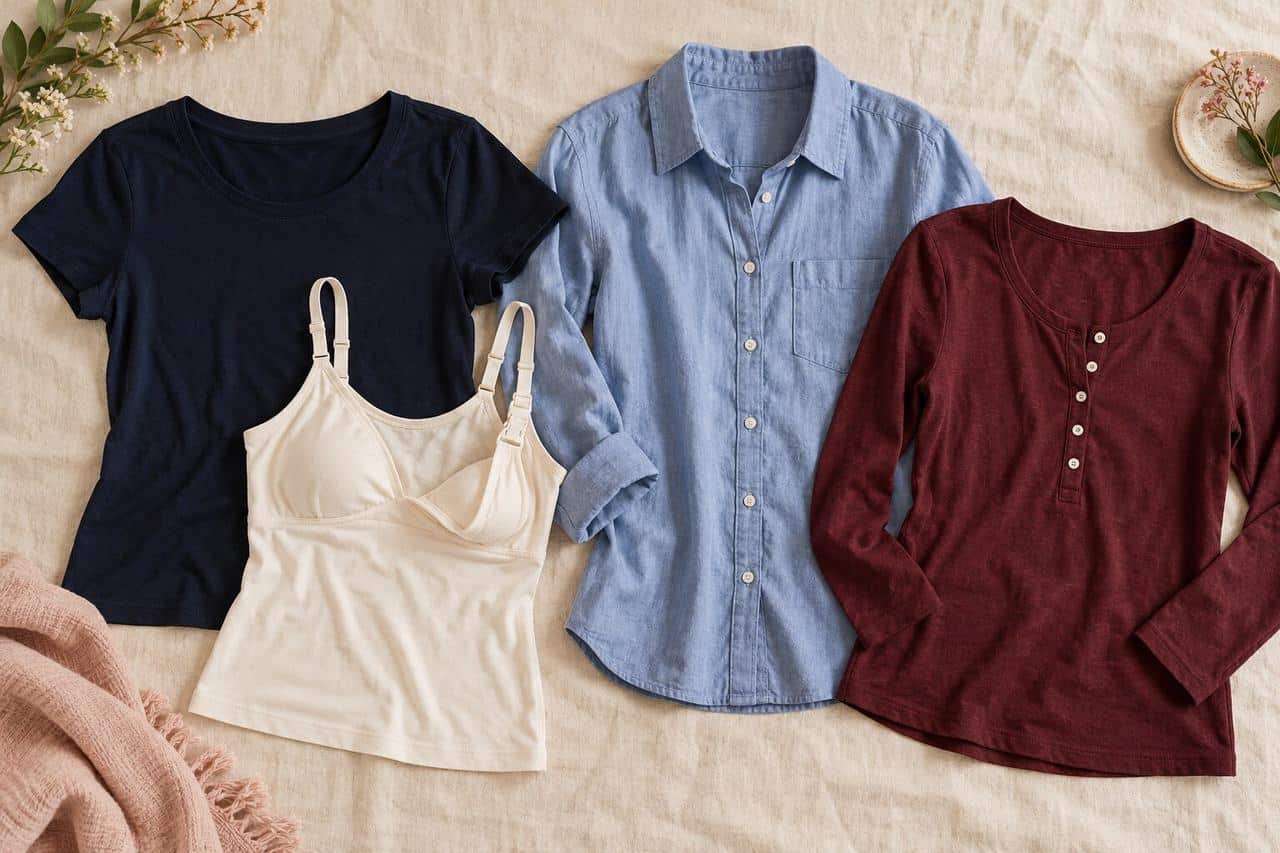
Pair a loose, liftable outer top with a tank or camisole that opens or moves down comfortably. The outer layer lifts while the lower layer stays over your middle. The NHS describes layering two stretchy tops as one possible clothing option for breastfeeding.
The useful word is “possible.” Two layers can feel too warm, create extra fabric, or make access more complicated for some people. Try the exact combination at home, with your usual bra, before deciding it is right for you.
A navy tee over a rose nursing tank with soft trousers is one example. Choose an outer tee that lifts easily and a lower layer with the access you prefer. Avoid a tight tank you have to drag out of shape or a long outer top trapped beneath several layers.
Check whether the tank rides up when the tee lifts. If both garments move together, try a different fabric pairing, a different length, or a single accessible top. The method should make the task simpler for you.
Let an ordinary button-front shirt do more
A shirt with functioning buttons can be worn closed, loosely tucked, or open over a suitable camisole. Start with enough room across the bust and shoulders to move and sit comfortably. If the front pulls while closed, opening the buttons for feeding will not solve the garment’s overall fit.
Try opening and closing the necessary buttons while seated. Tiny slippery buttons may be inconvenient even if the shirt looks lovely. A simple, easy-to-handle closure can be a more valuable feature than a special nursing label.
For a day at home, wear a soft blue shirt over a tank with joggers. For an appointment, close the shirt over pull-on trousers and add comfortable shoes. For work, check the same outfit with the bra and pump arrangement you expect to use.
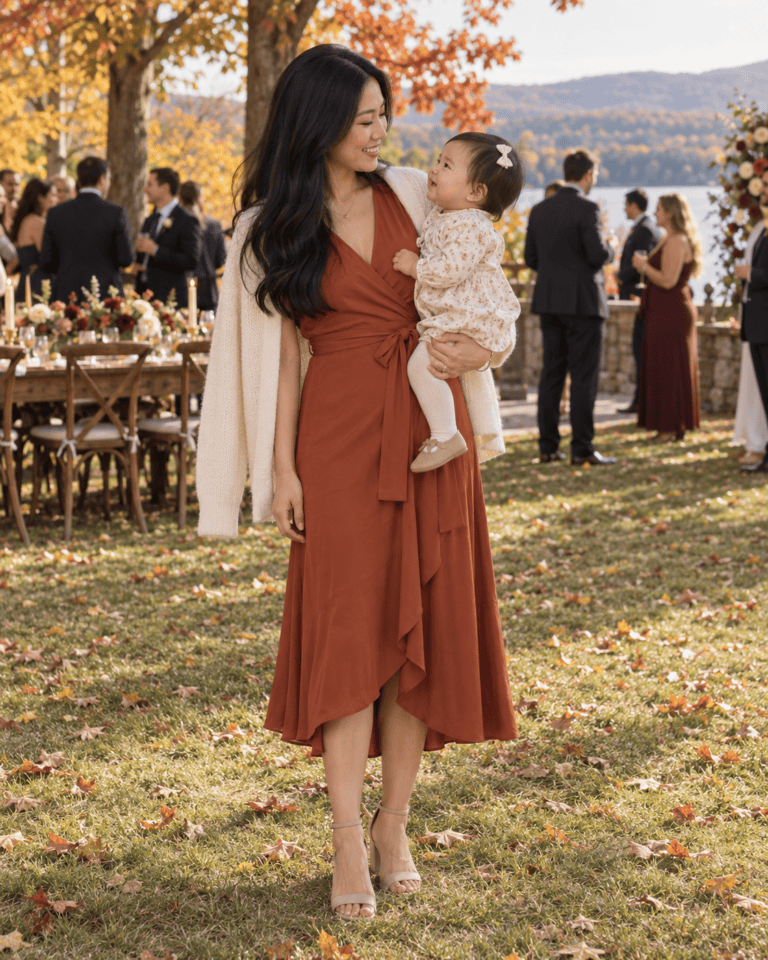
Test a wrap rather than trusting the word
A true wrap has an opening created by overlapping fabric. A faux wrap may only imitate that shape. Before choosing one for feeding, check the outer fabric, lining, inner tie, and any hidden fastening.
Try the garment seated and check whether you can move the overlap without loosening the entire dress more than you want to. Then bring the fabric back into place and stand up. An outfit that opens easily but needs constant readjustment afterward may not suit a busy day.
If you like the look but want more coverage, test a compatible accessible camisole underneath. Be aware that the added layer creates another opening to manage. Choose it because it improves your comfort, not because you are obliged to cover more.
Use a Henley only if its placket is useful
Henley tops can be practical because they combine a knit fabric with a front opening. However, the depth of the placket, size of the buttons, and amount of stretch vary.
Open the top and try the movement you need without force. If the placket ends too high or the neckline presses uncomfortably, it is not the right access route for you. A decorative row of three buttons near the collar is not automatically feeding-friendly.
Pair a suitable Henley with whatever bottoms feel good: a midi skirt, soft trousers, or leggings you enjoy wearing. You do not need to turn every accessible top into the same casual uniform.

Give high necklines a realistic role
A high neckline does not necessarily rule out breastfeeding, but you will need access somewhere else. A loose sweater may lift comfortably. A purpose-designed high-neck top may have a usable panel or hidden opening. A close-fitting ordinary turtleneck dress may offer neither.
Check fabric bulk as well as access. A thick sweater gathered above your chest can become cumbersome. If you like it as an outer layer, you may prefer to remove it and use an accessible top underneath.
Look closely at construction before buying. A concealed zipper in a product photo should correspond to a real opening with enough usable length. Avoid relying on an imagined opening or a vague “mom-friendly” description.
Try these ordinary-clothing combinations

| Piece you own | Possible adjustment | What to test |
|---|---|---|
| Loose tee | Wear over an accessible camisole | Both layers move independently |
| Button-front shirt | Wear loose over comfortable bottoms | Buttons, bust room, and seated access |
| True wrap blouse | Pair with a skirt or trousers already in rotation | Overlap, lining, and refastening |
| Roomy cardigan | Wear open over a top that supplies the access | Extra fabric stays manageable |
| Loose knit sweater | Lift or remove it over a suitable base | Bulk, warmth, and shoulder movement |
Try one change at a time. If you replace the bra, tank, top, and bottom together, it becomes harder to tell which piece improved the outfit and which created a new annoyance.
Run a seated test before taking the outfit out
Put on the complete outfit, including the bra or camisole. Sit in an ordinary chair and open or lift the layers. You can test the clothing movement without feeding your baby. Notice whether fabric drops back into the opening, a seam digs in, or you need to keep several pieces out of the way.
From the capsules
The Year Round Capsule
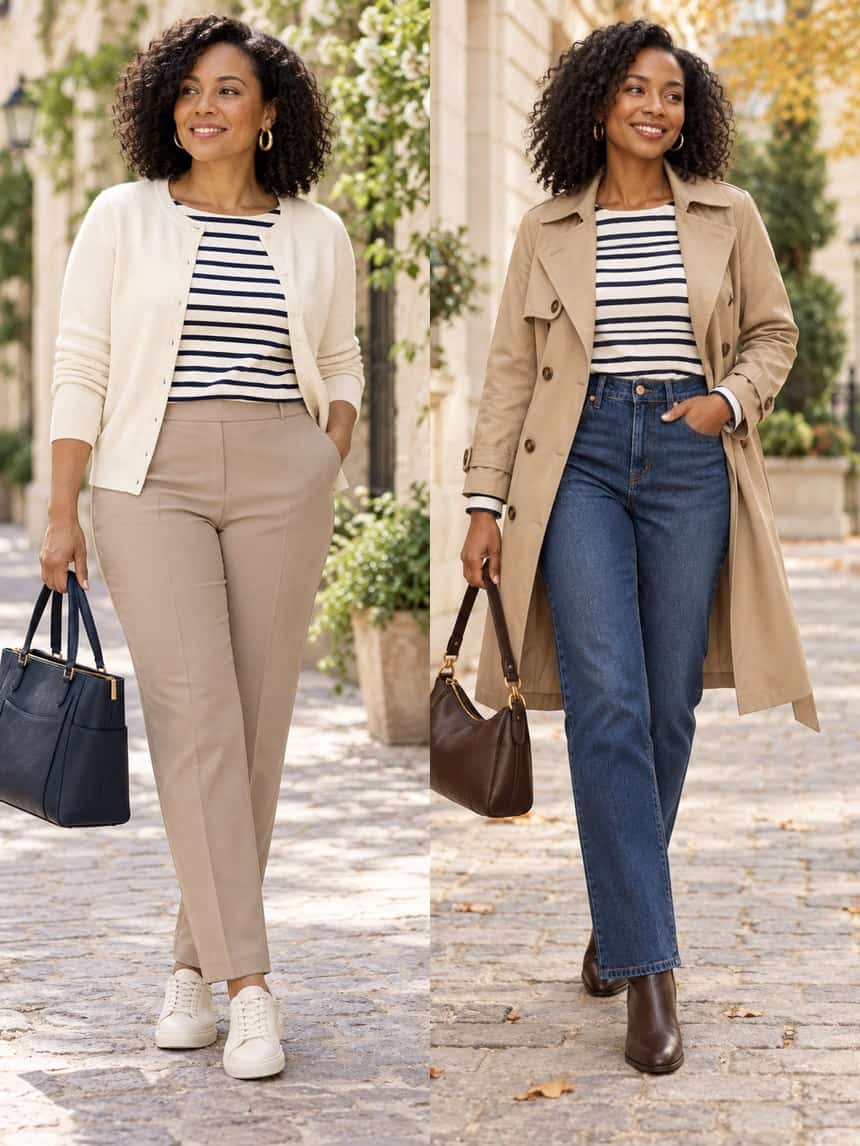
Two hundred nursing-friendly outfits from fifty-six pieces, fifty for every season, laid out and then worn. $29 once, yours to keep.
Restore the outfit, then stand, reach, and move as comfortably as your recovery allows. Check whether a hem stays where you want it and whether the bra remains accessible after tucking the top.
If you use a carrier, follow its instructions and consider whether clothing can be adjusted after taking your baby out. The NHS advises removing a baby from a sling or carrier before feeding. Do not turn an outfit demonstration into a reason to attempt feeding while moving around with a baby in a carrier.
Make a separate decision for pumping
A useful nursing outfit is not automatically a useful pumping outfit. You may need access on both sides, a particular supporting bra, or room to position and remove your equipment. Wearable cups also need to work with the bra and clothing specified for your setup.
Test with your own equipment and follow its manufacturer’s instructions. Avoid squeezing a pump into a tighter garment because it looks more discreet. Clothing convenience should not be the reason you continue with discomfort or an arrangement that does not work.
If a work outfit needs too much changing, simplify the outer layers first. A familiar shirt and suitable bra may be easier to manage than a dress, restrictive lining, and extra shapewear.
Know when tailoring is worth considering
A tailor may be able to adjust a hem, replace a difficult fastening, or discuss whether a particular seam can accommodate an opening. Feasibility depends on the fabric and construction. Ask for a clear proposal and price before committing.
Start with a garment you already enjoy and expect to wear often. A complicated alteration to a piece that still feels wrong in the shoulders is unlikely to solve the whole outfit. Avoid improvised cutting or loose fastening hacks on a garment you need immediately.
Your questions, answered
Do I need a nursing wardrobe?
You may find a few dedicated pieces helpful, but you can also use ordinary garments with suitable openings. Build from what works on your body and in your routine.
Is every V-neck breastfeeding-friendly?
No. Depth, stretch, fit, and construction matter. If you have to pull hard or distort the garment, use a different access route.
Do I have to use a cover?
Your comfort and preference should guide that choice. Layering can be useful if you like it, but an outfit does not need extra coverage to count as appropriate.
The Nursing Mama Fashion Commandments
Twelve rules I wish someone had told me postpartum. Print them. Screenshot them. Live by them.
- Nursing bra always. Regular bras become instruments of pain the day letdown surprises you.
- Nursing pads on your body + a spare pair in your bag. Every single time you leave the house. No exceptions.
- Extra top in your bag — for YOU, not the baby. Because leaks, spit-up, and coffee-spills don’t care about your outfit plan.
- If it takes more than 5 minutes to figure out how to nurse or pump in it, it’s not the right outfit today. Feeding access is comfort. Comfort is not optional.
- Belt under the bust (empire) or below the belly with drape — never at the belly button. Your postpartum body deserves flattery, not compression.
- Comfortable waistband is non-negotiable. Elastic, wrap, or pull-on. Zippers are a Sunday-only luxury for now.
- Dark tones, prints, or textures — not thin light solids. Because letdown marks are real and you deserve clothes that don’t advertise them.
- Machine-washable everything. Dry-clean is not real-mama fashion. If it can’t survive a spit-up rinse, it’s not in rotation.
- Cross-body bag only. Hands stay free for the carrier, the toddler, the coffee, the door, the meltdown.
- Comfortable shoes always. You’re carrying a car seat and a diaper bag. This is not the season for a heel you can’t run in.
- Get dressed BEFORE the kids see you if you can. It changes the whole day — for them and for you.
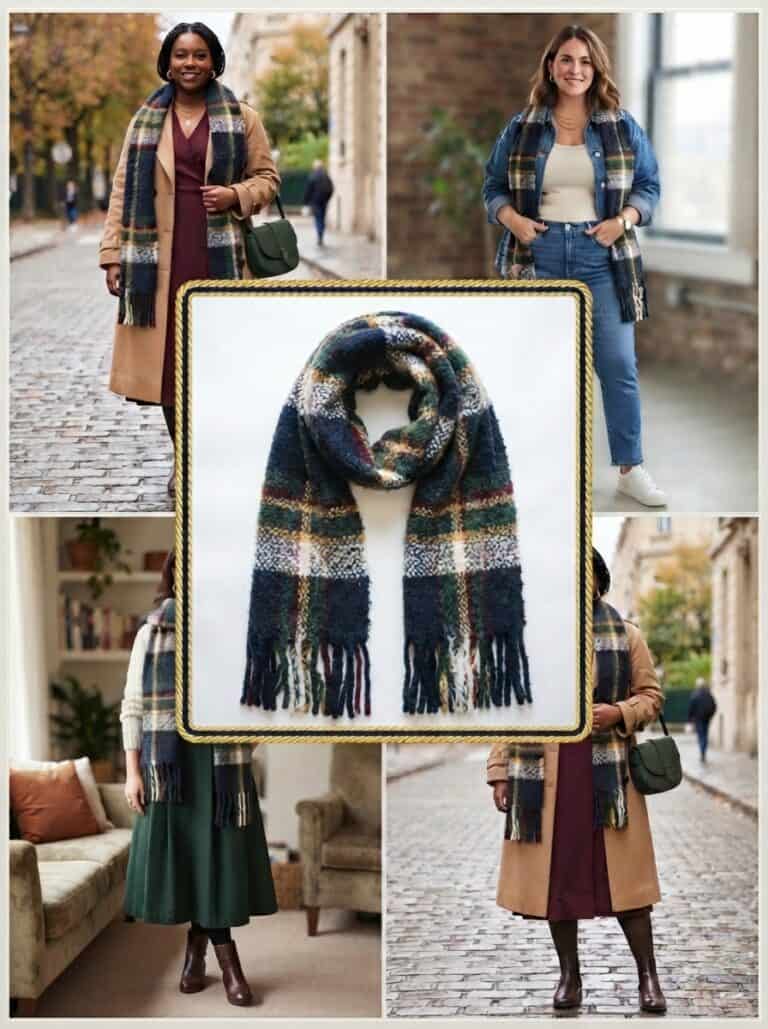
- One accessory — earrings, a lip color, a scarf — counts as “put together.” That’s the whole game. You get to feel like yourself again.
Rescue one outfit you already like
Choose a familiar top, test its opening, and pair it with one comfortable bottom. Take a photo when you find a combination that works so you do not have to solve it again next week.
You can make room for breastfeeding without setting aside your whole sense of style. For more ways to build practical outfits from your own wardrobe, explore The NennVersa Atelier.