A swimsuit can look as though it will be easy to breastfeed in and still prove awkward once you try to move the neckline. The straps may not adjust the way you expected. The lining may stay in place while the outer fabric moves. A one-piece may fit your bust but pull through your torso.
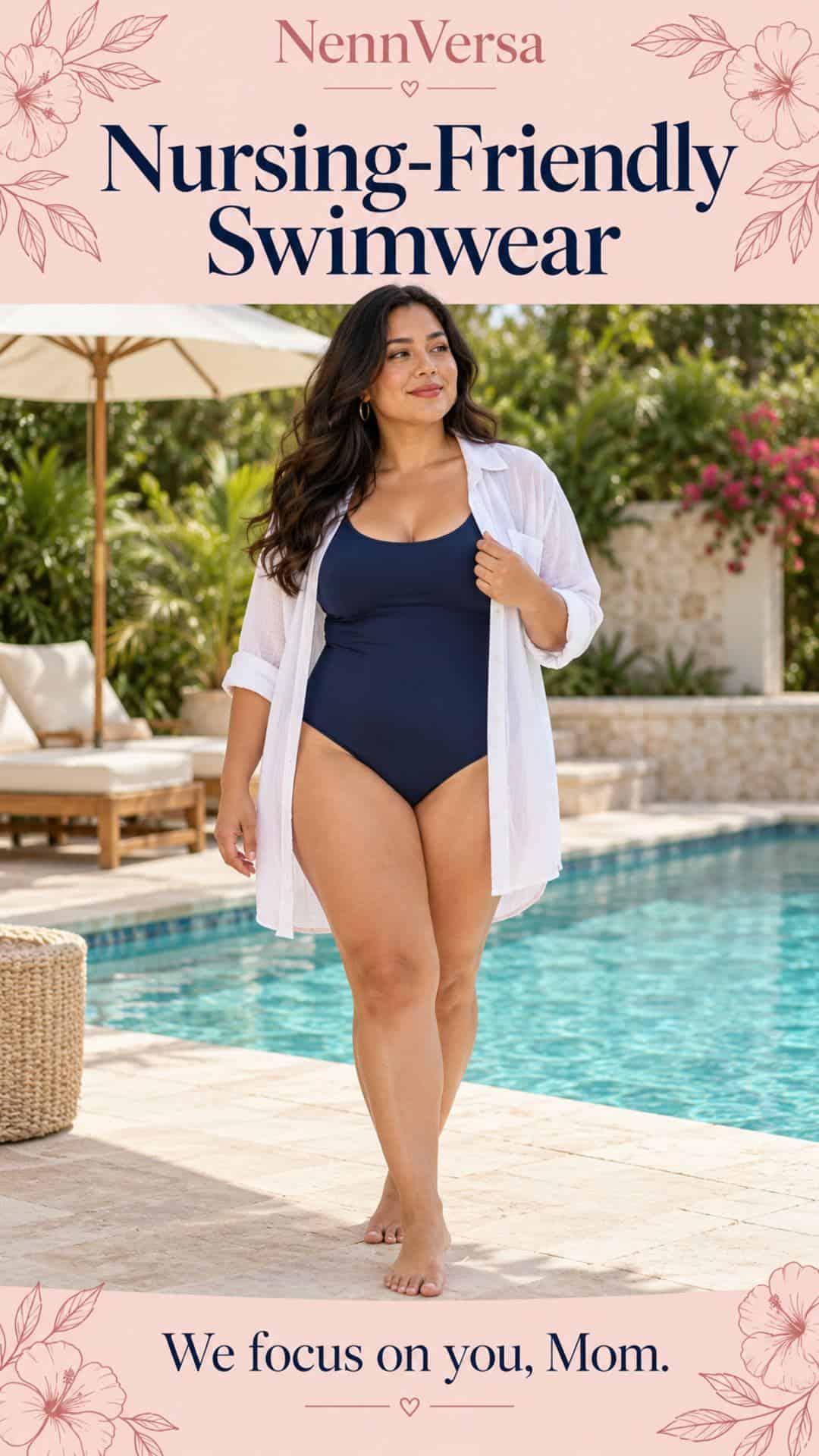
You do not need to guess from the product photograph. A few specific questions can help you choose swimwear that suits your body, your preferred coverage, and the way you plan to feed during an outing.
Start with what the garment actually does. A nursing label can be useful, but it is not a substitute for checking the opening, support, length, and returns policy.
Separate swimwear shopping from readiness to swim
Finding a comfortable swimsuit does not establish whether your body is ready to return to swimming after birth. Follow your own recovery advice, especially after surgery or complications.
NHS Inform’s post-birth activity guidance says to wait until postnatal discharge has stopped and stitches have healed before swimming. Ask your clinician about your circumstances rather than treating a particular week or a comfortable outfit as automatic permission.
You can still plan a poolside or beach outfit while waiting to swim. Decide whether the day involves entering the water, sitting beside it, or simply spending time with family. Those are different wardrobe needs, and you can dress for the one that applies to you.
Decide how you want to access the breast
Swimwear may offer nursing clips, a functional wrap front, an opening panel, or a neckline that the manufacturer intends to move for access. Each construction deserves its own check.
A decorative crossover is not necessarily a usable opening. A zip may be too short or positioned differently from what you need. A strap that looks detachable may be designed for styling rather than repeated feeding access.
Read the description, look at close-up photographs, and ask the seller how the opening works. If possible, check a video that shows opening and closing rather than only a model wearing the swimsuit.
A useful question is: “Can you show how both the outer fabric and the lining move for feeding?” That gives you more information than asking whether the swimsuit is “breastfeeding friendly.”
Compare the shapes without assigning one to your body
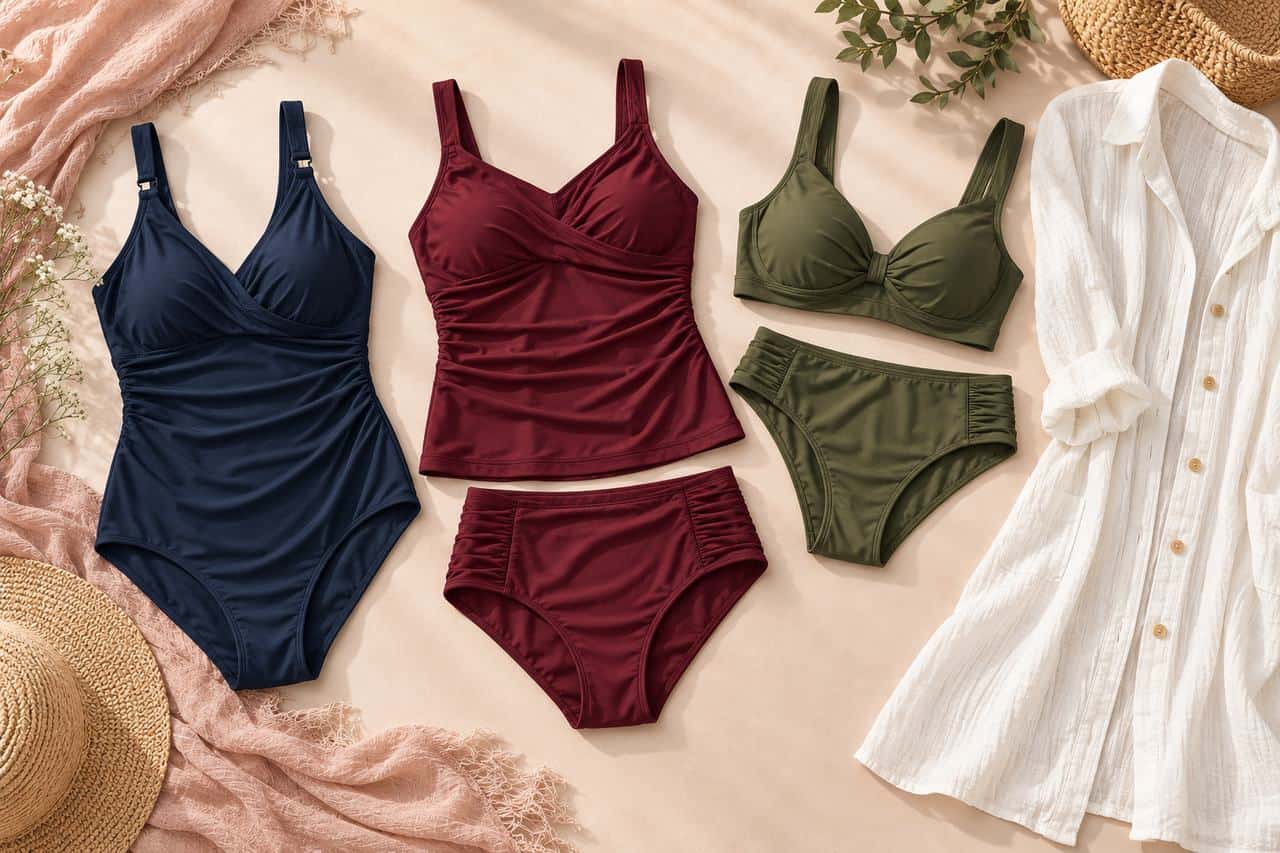
| Swimwear option | Potential advantage | Detail to inspect |
|---|---|---|
| One-piece with a nursing opening | A continuous garment with the abdomen coverage you may prefer. | Torso length, opening position, lining, and how it feels when seated. |
| Tankini with a separate bottom | You may be able to choose different top and bottom sizes. | Whether the top opens or needs lifting, and what happens to the hem when you reach. |
| Two-piece with an accessible top | Separate sizing and fewer connected areas to fit. | Band comfort, cup room, strap adjustment, and the actual feeding route. |
| Swim top or rash guard over a suitable swim layer | Additional coverage if that is your preference. | How both layers move, whether the front opens, and the extra steps needed for access. |
You do not have to choose a one-piece because you are postpartum, or a two-piece because you are breastfeeding. Pick the construction you want to wear and evaluate it on its own details.
If you prefer more coverage at the arms, chest, abdomen, or legs, name those areas separately. That makes shopping more precise than looking for one vague category of “covered” swimwear.
Check bust room and support as separate questions
A top can have enough fabric over the bust and still feel uncomfortable at the band or straps. It can also feel secure while its opening is difficult to use.
Try the garment using the retailer’s hygiene and return instructions. Notice whether the band rests comfortably, whether cup edges press or cut across the breast, and whether straps can be adjusted without making another area pull.
Do not solve every fit issue by tightening the straps. If the garment feels wrong in several places, a different cup construction, band size, or overall cut may be more useful.
If your breasts vary in fullness across the day, think about when you are likely to wear the swimwear and whether its fit has some comfortable flexibility. You do not need to buy a particular size up automatically. Assess the garment you are considering.
Give a one-piece a torso-length check

When a one-piece pulls at the shoulders or feels uncomfortable through the crotch, the issue may involve length as well as width. A larger size is not the only possible answer; a different torso length or cut may suit you better.
Sit down, reach gently, and stand up during your dry try-on, staying within movements that are comfortable for your recovery. Notice whether the neckline changes position, the leg openings dig in, or the waist seam lands somewhere you dislike.
Ask for garment measurements and the method used to take them if length is a recurring issue. A model’s height can provide context, but it cannot tell you how the garment will fit your own torso.
For a tankini, check the overlap between top and bottom while sitting and reaching. Choose the amount of coverage you prefer; there is no required overlap measurement for every body.
Rehearse the opening and the closing
With the garment dry and handled according to the return policy, try the feeding opening without holding your baby. Notice how many movements it takes and whether you can close it comfortably afterward.
Look at where the released panel or strap goes. Does a lining remain in the way? Does the other side of the top stay where you want it? Can you restore your preferred coverage without taking off the garment?
A dry try-on has limits: it cannot fully show how fabric and fastenings will behave when wet. Read the care instructions and ask the seller about the design rather than wetting an item you may need to return.
Do not assume that a nursing swimsuit is suitable for holding a pump. If you plan to express milk during the outing, bring the appropriate bra and equipment and arrange a suitable dry place to use them according to their instructions.
From the capsules
The Year Round Capsule
Two hundred nursing-friendly outfits from fifty-six pieces, fifty for every season, laid out and then worn. $29 once, yours to keep.
Plan the clothes you will wear around the water
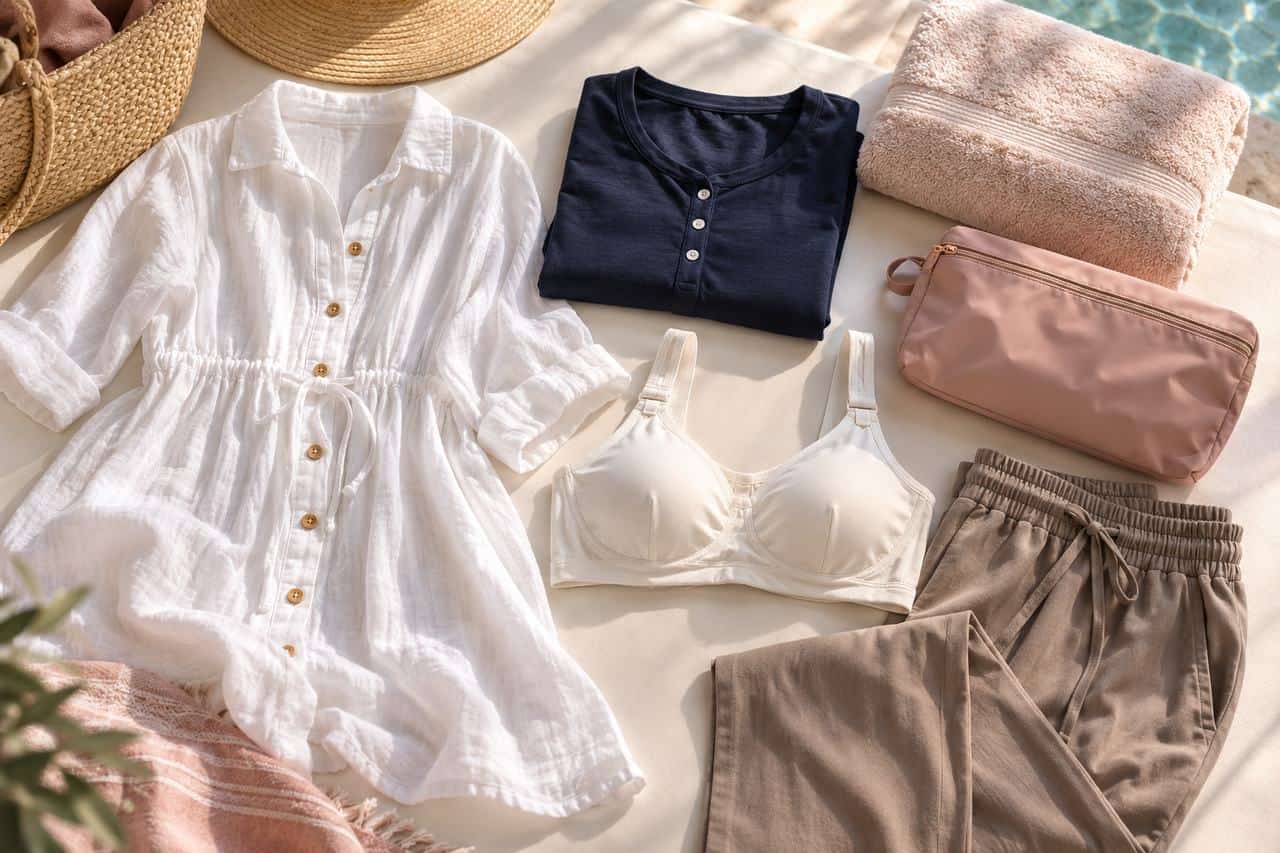
Your cover-up may spend more time on your body than the swimsuit. Choose one whose opening supports the same plan.
A button-front shirt over a swimsuit can be easy to open. A wrap skirt lets the top remain separate. A high-neck, non-opening dress may require removal even if the swimsuit underneath has excellent access.
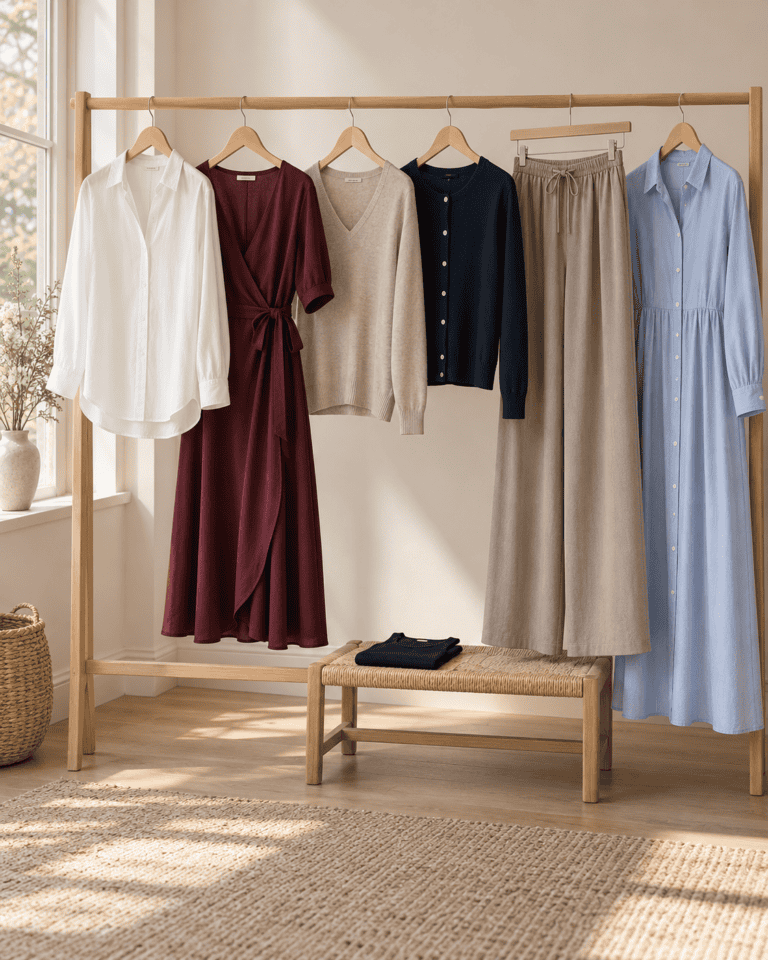
Try one complete combination: for example, a navy nursing-access swimsuit, a loose white button-front shirt, and a soft wrap skirt. Or choose a burgundy tankini with a front-opening swim layer and the bottom coverage you prefer.
Pack dry clothing with familiar feeding access for afterward. Include your usual underlayers and a separate place for wet items so the spare stays usable. A spare outfit you already like is more helpful than a cover-up you can only wear in one setting.
Read the policy before removing tags
Swimwear return conditions can be more specific than those for an ordinary top. Check the seller’s current rules for hygiene liners, tags, try-ons, sale items, and returns by post.
Keep packaging and labels until you have completed the allowed checks. Follow the care label after deciding to keep the garment, including any instructions for rinsing and drying.
If you are buying online, save the product details that informed your choice: the opening description, size chart, and relevant correspondence. This also helps you remember which design features to look for next time.
Frequently asked questions
Can an ordinary swimsuit work for breastfeeding?
Possibly, if its intended construction allows comfortable access. Do not assume that forcing a neckline or strap aside will work well simply because the fabric stretches.
Do I need to wear a nursing bra underneath?
Do not assume a regular bra is designed for swimming. Check the swimwear’s support and the manufacturers’ intended use. For a pumping break, you may prefer to change into your usual suitable pumping setup in a dry space.
Should I buy for the size I expect to be later?
Buy for the fit you need now, or wait until closer to the outing if that is practical. A future body-size prediction is a weak basis for choosing a fitted garment with a limited return window.
The Nursing Mama Fashion Commandments
Twelve rules I wish someone had told me postpartum. Print them. Screenshot them. Live by them.
- Nursing bra always. Regular bras become instruments of pain the day letdown surprises you.
- Nursing pads on your body + a spare pair in your bag. Every single time you leave the house. No exceptions.
- Extra top in your bag — for YOU, not the baby. Because leaks, spit-up, and coffee-spills don’t care about your outfit plan.
- If it takes more than 5 minutes to figure out how to nurse or pump in it, it’s not the right outfit today. Feeding access is comfort. Comfort is not optional.
- Belt under the bust (empire) or below the belly with drape — never at the belly button. Your postpartum body deserves flattery, not compression.
- Comfortable waistband is non-negotiable. Elastic, wrap, or pull-on. Zippers are a Sunday-only luxury for now.
- Dark tones, prints, or textures — not thin light solids. Because letdown marks are real and you deserve clothes that don’t advertise them.
- Machine-washable everything. Dry-clean is not real-mama fashion. If it can’t survive a spit-up rinse, it’s not in rotation.
- Cross-body bag only. Hands stay free for the carrier, the toddler, the coffee, the door, the meltdown.
- Comfortable shoes always. You’re carrying a car seat and a diaper bag. This is not the season for a heel you can’t run in.
- Get dressed BEFORE the kids see you if you can. It changes the whole day — for them and for you.
- One accessory — earrings, a lip color, a scarf — counts as “put together.” That’s the whole game. You get to feel like yourself again.
Buy for a day you can picture
Choose the swimwear, the cover-up, and the dry change as one outfit plan. Check how you will feed or pump during the outing, then keep the garment decisions as simple as possible.
You deserve swimwear you enjoy wearing without a requirement to hide, reshape, or prove anything about your postpartum body. Find more practical wardrobe support through The NennVersa Atelier at NennVersa.